
Titanium fasteners
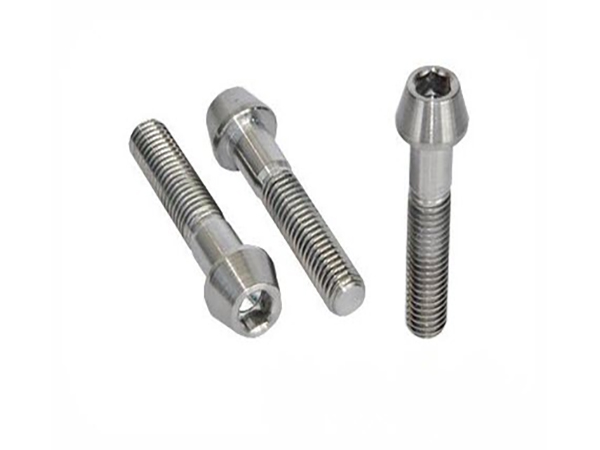
DefinitionTitanium alloy fasteners are various types of connectors made of titanium alloy, such as bolts, nuts, rivets, etc., used in aerospace and other fields.It has the advantages of low density, h...
Product Details
Definition
Titanium alloy fasteners are various types of connectors made of titanium alloy, such as bolts, nuts, rivets, etc., used in aerospace and other fields.
It has the advantages of low density, high strength, and corrosion resistance, and is an indispensable and important basic component in modern industry.
Classification
Divided by shape into bolts, screws, nuts, rivets, etc; Divided by performance into different types such as high strength, high toughness, and high temperature resistance.
Different types of titanium alloy fasteners are suitable for different application scenarios, meeting diverse engineering needs.
Mechanical Properties
1. High intensity
The tensile strength of titanium alloy fasteners can reach 1000-1500MPa, which is comparable to high-strength steel, but the density is only 58% of steel.
For example, the tensile strength of Ti-6Al-4V alloy can reach over 895MPa and is widely used in the aerospace industry.
2. High yield to strength ratio
The yield strength of titanium alloy is close to its tensile strength, with a high yield strength ratio and high safety.
This makes titanium alloy fasteners less prone to plastic deformation when subjected to high loads, maintaining good connection performance.
3. Good fatigue performance
Titanium alloy fasteners have excellent fatigue performance and can withstand repeated alternating loads.
In the aerospace field, aircraft takeoff and landing, vibration during flight, and other factors can cause fatigue on fasteners. Titanium alloy fasteners can effectively address these challenges.
Physical properties
1. Low density
The density of titanium alloy is generally around 4.5g/cm ³, which is only 60% of that of steel, and can significantly reduce the weight of the structure.
For example, the Boeing 747 aircraft reduced its total weight by 1814kg by using titanium alloy fasteners instead of steel fasteners.
2. High melting point
The melting point of titanium alloy is significantly higher than that of steel materials, and it has good heat resistance, making it suitable for use in high-temperature environments.
Some titanium alloy fasteners can work for a long time at temperatures of 350 ℃ or even higher, meeting the high temperature requirements of aerospace and other fields.
3. Small coefficient of thermal expansion
Titanium alloy has a low coefficient of thermal expansion and good dimensional stability under temperature changes.
This makes titanium alloy fasteners less prone to loosening or deformation during thermal expansion and contraction, ensuring the reliability of the connection.
chemical properties
1. Chemical properties
Titanium alloys have excellent corrosion resistance and can maintain good performance even in harsh environments.
For example, in marine environments or chemical equipment, titanium alloy fasteners can effectively resist corrosion from media such as seawater, acid and alkali.
2. Non-magnetic
The magnetic permeability of titanium alloy is extremely low, almost negligible, and has good non-magnetic properties.
This makes titanium alloy fasteners suitable for devices sensitive to magnetic fields, such as avionics equipment, to avoid magnetic field interference.
3. Good compatibility with carbon fiber composite materials
The electrode potential of titanium alloy matches that of carbon fiber composite material, which can effectively prevent galvanic corrosion.
In the aerospace field, the combination of titanium alloy fasteners and carbon fiber composite materials is becoming increasingly widespread, improving the performance and reliability of structures.
plastic deformation
1. Top heading
Topping is the process of deforming the head of a titanium alloy billet under pressure to form the desired shape.
For example, when manufacturing bolt heads, the size and shape required by the design can be achieved through the upsetting process.
2. Reduce diameter
Reducing diameter is the process of reducing the diameter of titanium alloy billets to meet the dimensional requirements of fasteners.
This process can improve the utilization rate of materials while ensuring the dimensional accuracy of fasteners.
3. Roll thread
Thread rolling is the process of machining threads on titanium alloy billets using rolling technology.
Rolled threads have high precision and strength, and good surface quality, which can meet the strict requirements of aerospace and other fields.
surface strengthening
1. Strengthening of load-bearing surface
Strengthen the load-bearing surface of titanium alloy fasteners, such as sandblasting, shot blasting, etc.
These treatments can improve the hardness and wear resistance of the load-bearing surface, and enhance the load-bearing capacity of fasteners.
2. Underhead rounded corner reinforcement
Using a fillet strengthening machine to reinforce the front and lower fillets, resulting in residual compressive stress.
Residual compressive stress can improve the fatigue strength of fasteners and prevent fracture caused by stress concentration.
3. Surface treatment of threads
Perform anodizing, aluminum plating, and lubricating coating treatment on the surface of the thread.
These treatments can improve the corrosion resistance, wear resistance, and lubrication performance of threads, and extend the service life of fasteners.
Machining
1. Turning and turning
Turning is one of the commonly used machining processes in the manufacturing of titanium alloy fasteners.
By turning, the outer circle, end face, and other parts of fasteners can be machined to ensure their dimensional accuracy and surface quality.
2. Milling
Milling is used to process complex shaped parts of fasteners, such as the groove shape of bolt heads.
Precision milling can achieve high-precision machining and meet the strict requirements of aerospace and other fields.
3. Grinding
Grinding is an important process for precision machining of titanium alloy fasteners.
It can improve the dimensional accuracy and surface smoothness of fasteners, ensuring their assembly accuracy and connection performance.
Aerospace field
1. Aircraft structural connections
Titanium alloy fasteners are widely used for connecting components such as aircraft skeletons, skins, and engines.
For example, large aircraft such as Boeing 787 and Airbus A380 extensively use titanium alloy fasteners, significantly reducing aircraft weight and improving fuel efficiency.
2. Spacecraft Connection
In the manufacturing of spacecraft, titanium alloy fasteners are used to connect key components such as rocket engines and satellite structures.
For example, Russia's Tu-204 aircraft uses 940kg BT16 titanium alloy fasteners, reducing the weight of steel by 688kg and improving the performance and reliability of the spacecraft.
3. Aircraft engine
Titanium alloy fasteners play an important role in the connection of components such as fans, compressors, and combustion chambers in aircraft engines.
Its high strength, high temperature resistance, corrosion resistance and other properties can meet the working requirements of aircraft engines in harsh environments such as high temperature, high pressure, and high-speed rotation.
In the field of electronics and semiconductors
1. Electronic device assembly
During the assembly process of electronic devices, titanium alloy fasteners are used to connect components such as circuit boards and casings.
Its non-magnetic and corrosion-resistant advantages can ensure the normal operation of electronic devices, prevent electromagnetic interference and corrosion damage.
2. Semiconductor equipment manufacturing
Titanium alloy fasteners are used in the manufacturing of semiconductor equipment, such as etching machines, lithography machines, etc.
Its corrosion resistance, high temperature resistance and other properties can meet the working requirements of semiconductor equipment in high-purity, high temperature and other environments, ensuring the stability and reliability of the equipment.