
Titanium Machined Parts
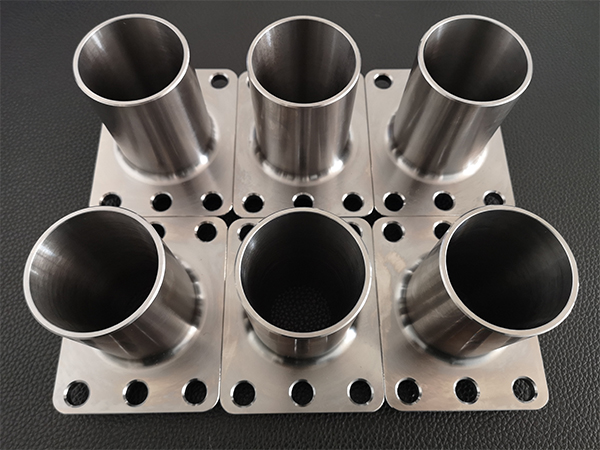
Physical and chemical properties of titanium alloys1. The influence of low-density characteristics on processingThe density of titanium alloy is usually around 4.5g/cm ³, which is lower than that of ...
Product Details
Physical and chemical properties of titanium alloys
1. The influence of low-density characteristics on processing
The density of titanium alloy is usually around 4.5g/cm ³, which is lower than that of metals such as steel. This allows for a reduction in overall weight when processing large components. However, low density also leads to relatively low material rigidity, which is prone to deformation during processing and requires high requirements for clamping and processing technology.
2. The influence of high specific strength characteristics on processing
Titanium alloys have a high specific strength, which is the ratio of strength to density. This means that material usage can be reduced while ensuring the strength of the components. However, high specific strength results in greater cutting force and faster tool wear for titanium alloys, requiring the use of high-performance tools and reasonable cutting parameters.
The Influence of Corrosion Resistance Characteristics on Processing
The surface of titanium alloy can form a dense oxide film, which has good corrosion resistance. During the processing, this oxide film may affect the processing accuracy and surface quality, and special processing techniques are required to avoid damage and uneven removal of the oxide film.
The role of machining in titanium alloy manufacturing
1. Realize precise dimensional accuracy
The machining process can control the dimensional accuracy of titanium alloy components within a very small range. For example, through CNC machining, the dimensional tolerance can reach ± 0.01mm or even higher accuracy, meeting the strict requirements for component dimensions in aerospace and other fields.
2. Ensure the formation of complex shapes
For titanium alloy components with complex shapes, such as aircraft engine blades, machining can achieve precise forming through processes such as milling and grinding, ensuring their aerodynamic and mechanical performance.
3. Improve surface quality
Machining can effectively improve the surface roughness of titanium alloy components, achieving a surface smoothness of Ra0.8-Ra1.6 μ m, and enhancing the corrosion resistance and fatigue performance of the components.
Here are some common names of machined parts made of titanium alloy materials:
1. Aerospace field
Aircraft engine blades: Titanium alloy blades have high strength, low density, and good fatigue resistance, which can effectively reduce engine weight and improve fuel efficiency.
Aircraft landing gear components, such as landing gear struts and connectors, utilize the high strength and corrosion resistance of titanium alloy to ensure the safety and reliability of aircraft during takeoff and landing.
Body structural components: including body frame, beams, ribs, etc. The application of titanium alloy helps to reduce the weight of the body while maintaining sufficient structural strength.
2. Health field
Implantable devices: such as artificial joints, spinal fixation systems, bone nails, dental implants, etc. Titanium alloys have good biocompatibility, corrosion resistance, and low elastic modulus, matching the mechanical properties of human bones.
Surgical instruments such as surgical knives, scissors, forceps, etc. The corrosion resistance and high strength of titanium alloy enable it to maintain good performance during disinfection and use.
3. Marine field
Ship propellers, titanium alloy propellers have excellent resistance to seawater corrosion and high strength, which can improve the propulsion efficiency and service life of ships.
Seawater heat exchanger components: Titanium alloy exhibits good corrosion resistance in seawater environment and is suitable for manufacturing tube sheets, tubes and other components of heat exchangers.
Ship structural components, such as hull frames, deck supports, etc., the application of titanium alloys helps to reduce the weight of ships and improve their navigation performance.
4. Automotive field
Engine components such as valves, valve springs, connecting rods, etc. The high strength and low density of titanium alloy help reduce the weight of engine components and improve engine performance.
Suspension system components such as suspension springs, brake caliper pistons, etc. The application of titanium alloy can reduce the weight of the suspension system and improve the handling performance of the vehicle.
5. Industrial sector
Pressure vessels: Titanium alloy pressure vessels have good corrosion resistance and high strength, suitable for storing and transporting various corrosive media.
Chemical equipment components, such as pumps, valves, pipelines, etc., are widely used in the chemical industry due to the corrosion resistance of titanium alloys.
Mechanical transmission components such as gears, shafts, bearings, etc. The high strength and wear resistance of titanium alloy can improve the performance and service life of mechanical transmission systems.