
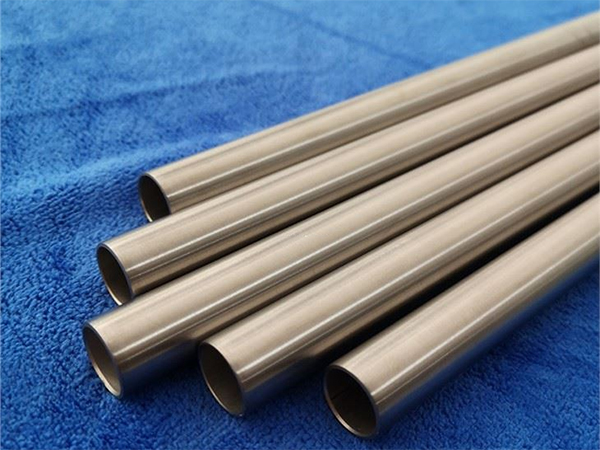
titanium tube
Definition and characteristics of titanium alloy pipes1. Definition of titanium alloy pipesTitanium alloy tube is a tubular product made of titanium alloy, which has characteristics such as high stren...
Product Details
Definition and characteristics of titanium alloy pipes
1. Definition of titanium alloy pipes
Titanium alloy tube is a tubular product made of titanium alloy, which has characteristics such as high strength, low density, and corrosion resistance.
Widely used in aerospace, chemical and other fields, its specifications have a significant impact on performance and application scope.
2. Characteristics of titanium alloy pipes
Titanium alloy pipes have a low density, only 60% of steel, and have significant advantages in reducing structural weight.
It has excellent corrosion resistance and can work stably for a long time in various harsh environments.
3. Classification of titanium alloy pipes
It can be divided into industrial titanium alloy pipes and medical titanium alloy pipes according to their purposes.
According to the production process, it can be divided into seamless titanium alloy pipes and welded titanium alloy pipes.
The importance of specifications for titanium alloy pipes
1. Affects performance
The wall thickness and outer diameter of titanium alloy pipes of different specifications will affect their pressure bearing capacity and bending strength.
For example, pipes with thicker walls are suitable for high-pressure environments, while pipes with larger outer diameters are more suitable for withstanding larger external forces.
2. Determine the application field
Small sized titanium alloy pipes are commonly used in precision instruments and medical devices, such as heart stents.
Large scale titanium alloy pipes are widely used in large-scale structural components in the aerospace and chemical industries.
3. Relationship cost-effectiveness
The size of the specifications directly affects the production cost and processing difficulty of titanium alloy pipes.
Reasonable selection of specifications can reduce material costs and processing expenses while meeting usage requirements.
Small sized titanium alloy pipes
1. Size range
The outer diameter is generally between 6mm and 25mm, and the wall thickness is between 0.5mm and 2mm.
This specification of pipe has high strength and good flexibility.
2. Application Fields
Widely used in health equipment such as heart stents, orthopedic implants, etc.
It is also used in the manufacturing of precision instruments, such as conduits in fiber optic communication equipment.
3. Production process characteristics
Adopting cold drawing or cold rolling processes to ensure dimensional accuracy and surface quality.
High requirements are placed on the purity of raw materials and the precision of processing equipment.
Large specification titanium alloy pipes
1. Size range
The outer diameter is between 100mm and 630mm, and the wall thickness is between 10mm and 40mm.
Strong pressure bearing capacity, suitable for large structural components.
2. Application Fields
The fuselage structural components used in the aerospace industry for large aircraft.
Pipelines used in large reactors and heat exchangers in the chemical industry.
3. Production process characteristics
Adopting hot extrusion or hot rolling processes to ensure the strength and toughness of the pipes.
The tonnage and precision requirements for production equipment are high, making production difficult.
Cost benefit evaluation
1. Material cost
The material cost of titanium alloy pipes of different specifications varies, and the cost of large-sized pipes is higher.
Reasonable selection of specifications can reduce costs while meeting demand.
2. Service life
Choosing the appropriate specifications can extend the service life of pipes and reduce replacement costs.
Considering long-term usage costs, choose specifications with high cost-effectiveness.
3. Processing cost
The precision requirements for processing small-sized pipes are high, and the processing cost is also high.
The processing of large-sized pipes is difficult, with large equipment investment and high processing costs.